



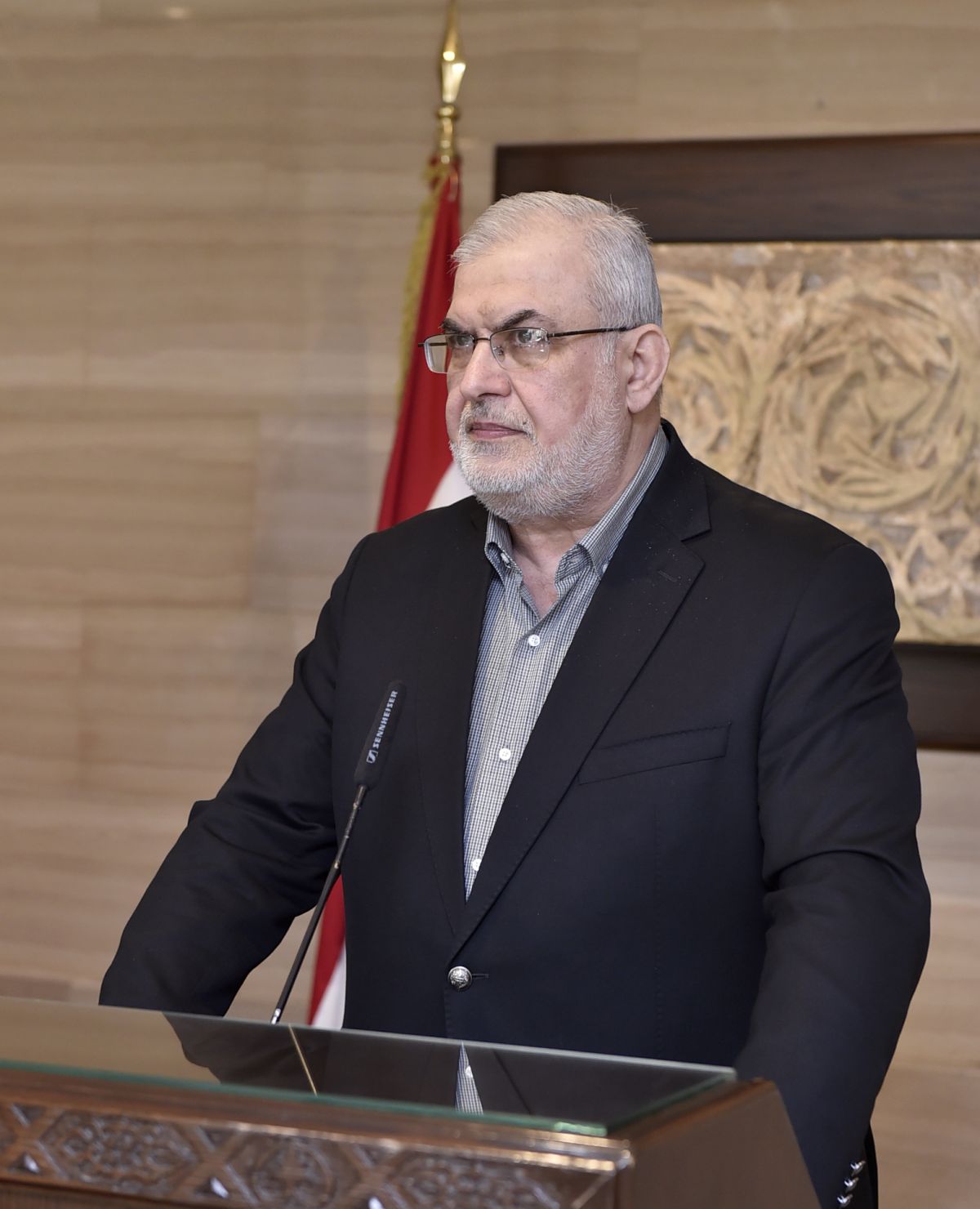
The head of Hezbollah’s parliamentary bloc, Mohammad Raad. (Credit: Hassan Ibrahim/Lebanese Parliament)



The head of Hezbollah's parliamentary bloc, Mohammad Raad, issued a statement Monday in which he criticized the government's decision to ban all "military and security activities" by Hezbollah.
Just hours after rumors spread that he had been targeted by an Israeli strike on Beirut's southern suburbs at dawn, Raad lashed out at comments made by Prime Minister Nawaf Salam following Monday morning's Cabinet meeting at the Baabda Presidential Palace.
"We understand the impotence of the Lebanese government in the face of the Zionist enemy, which violates national sovereignty, occupies territory and represents a permanent threat to the country's security and stability. We also understand its right to decide on war and peace, as well as its inability to implement this decision and impose it on an enemy that flouts national peace and continues its aggression against Lebanon and its people," Raad said.
"However, in the face of this impotence and these obvious failings, we see no reason for Prime Minister Salam and his government to take impractical decisions against Lebanese who refuse occupation, by accusing them of violating a peace that the enemy itself has renounced and has refused to uphold for a year and four months. [Israel] has imposed a daily state of war on the Lebanese, government and people, without the government managing to stop its attacks or even mobilize the international support it claims to have in order to force the enemy to end the war against our country... The Lebanese expected a decision banning aggression; instead, they face a decision banning the rejection of aggression," he added.
He stressed that, "Hezbollah's response is rooted in the rejection of a path of submission and in the attempt to convince Lebanese that reconciliation with the enemy and submission to its conditions constitute the only path toward illusory Lebanese security and peace."
"The Lebanese government, unable to impose peace on the enemy and equally unable to engage in resistance against aggression, should spare the country from creating additional problems likely to fuel the boiling state and tension that we should all work to avoid," he concluded.
On the third day of the American-Israeli offensive against Iran, Hezbollah launched "a salvo of missiles and a swarm of drones" toward Israel on Sunday night into Monday, claiming it was in response to the assassination of Iranian Supreme Leader Ali Khamenei on Saturday in Tehran.
The Israeli response was immediate: Heavy strikes targeted Beirut's southern suburbs and southern Lebanon.
Residents of 53 villages in southern Lebanon and the Bekaa were ordered to evacuate immediately, prompting thousands of people to flee, including from the southern suburbs of Beirut.
On Monday, Lebanon's Health Ministry reported 52 dead and 154 injured. Just hours after this painful night across Lebanon, the Israeli army warned Monday morning that it planned to "intensify" its strikes against the group.
Around 6 p.m., the Israeli army announced it had bombed "more than 70 Hezbollah targets" in Lebanon, targeting "weapons depots, launch sites and launchers" in a "large-scale attack."

 Trump affirme qu'un accord avec l'Iran « se rapproche grandement »
 Désarmement du Hezbollah : négocier avec l’Iran est-il réaliste ?