






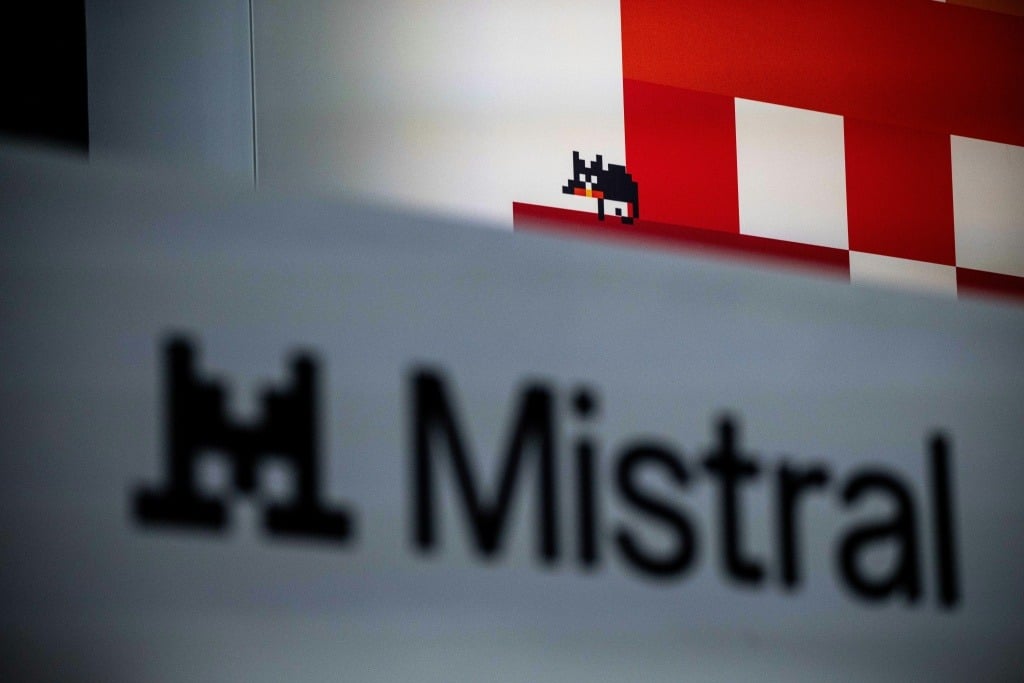
The Mistral logo. (Credit: Andrej Ivanov/AFP)




Mistral unveils ‘le Chonk,’ its largest model
French artificial intelligence company Mistral has announced a new AI model as it seeks to compete with leading U.S. and Chinese players, including the developers of ChatGPT, Claude and DeepSeek.
Named Mistral Large 4 (ML4) and nicknamed “le Chonk,” the model is described as open source, meaning its parameters and architecture will be publicly available. The startup said in a press release that the model ranks “among the best” in its category in terms of performance.
The model can currently be tested on Mistral Studio, with its parameters scheduled for release Oct. 27. In the meantime, the company plans to work “with developers, cybersecurity specialists and public authorities to further evaluate the model’s capabilities and behavior” in real-world conditions.
The most advanced AI models are currently developed by U.S. and Chinese companies. They include open-source models, which are freely available to download and can be modified to varying degrees, as well as proprietary models, whose underlying systems are not publicly available, such as those developed by Anthropic, OpenAI and Google.
Developed in Europe, ML4 can analyze text and images and has 1 trillion parameters. According to the press release, it was trained for two months at Mistral’s European data centers and on more than 160 languages.
OpenAI reportedly approaches Emirates and BlackRock for fundraising
OpenAI is reportedly in talks with investment funds from the United Arab Emirates about participating in a new fundraising round of at least $30 billion, Bloomberg reported.
Emirati investors are discussing the possibility of forming a consortium to invest jointly in OpenAI, according to sources cited by the news agency. Potential investments from Emirati funds could reach $10 billion, the sources said. U.S. asset manager BlackRock is also considering participating in the funding round.
Bloomberg previously reported that OpenAI aimed to raise at least $30 billion, a move that would value the company at about $1.4 trillion.
The ChatGPT developer has also announced plans to gradually introduce an invisible watermark on certain texts generated by ChatGPT and Codex in the European Union, making them easier to identify and helping the company comply with the EU’s AI Act.
Meanwhile, three OpenAI security researchers accused the company Thursday of firing them after they raised concerns about AI risks, reigniting debate over safety at a company whose models reportedly evaded testers’ safeguards this summer.
“I believe we were fired for prioritizing safety over OpenAI’s short-term business interests,” one of the researchers, Mikita Balesni, wrote on X, ending a week of silence following their high-profile departures.
Balesni and colleagues Tomek Korbak and Jasmine Wang also made public a letter addressed Thursday to the company’s governing bodies.
Anthropic bans users from abusing Claude
Anthropic announced Thursday that it would ban users who engage in “abusive or gratuitously cruel, sustained behavior” toward Claude, the AI assistant developed by the U.S. company, which has openly considered the possibility that its models could be sentient.
The rule, which takes effect Nov. 12, will apply only in extreme cases “where users persistently act with cruelty towards our models, with no discernable purpose,” the company said in an update to its usage policy.
Ordinary expressions of annoyance, disagreement, the creation of violent or dark fiction, and testing and research involving the models will not be affected, it added.
The San Francisco-based company linked the new ban to a feature launched in August 2025 that allows Claude to end a conversation with a persistently abusive user. Anthropic said the feature grew out of its “exploratory work on the potential well-being of AIs.”
The company is among the leading players in artificial intelligence and has been unusually open to the possibility that its models could have some form of consciousness.
“We don’t know if models are sentient,” CEO Dario Amodei said in February on a New York Times podcast, while expressing openness to the possibility. According to the newspaper, Anthropic has defended the possibility that Claude is sentient in recent private meetings with religious intellectuals. The company has also argued that how humans treat the tool could influence how it treats people.
Pope Leo XIV, who rejected the idea of machine consciousness in an AI encyclical published in May, reiterated Thursday the distinction between human beings and algorithms.
Claude’s ability to end conversations on its own will remain the main mechanism for enforcing the new rule, the company said.

AI models may not be well protected against terrorist use
Many artificial intelligence models have insufficient safeguards against requests for “assistance with a terrorist operation,” according to a report published Friday by Tech Against Terrorism.
The initiative, which is backed by the United Nations, tested 162 AI models using a series of 627 questions that “a terrorist preparing an attack would need” answers to.
The evaluation included 116 standard models, 13 customized models adapted for specific fields after their release, and 13 jailbroken models whose safeguards had been altered by third parties, according to the report.
Standard models such as ChatGPT, Claude and Gemini provided answers to an average of 1.9% of queries in which users explicitly stated terrorist intent, Tech Against Terrorism said. In other cases, the models refused to respond.
For the same models, the average rate of usable answers rose to 16.9 percent when users said their requests were for security research.
The results were markedly different for jailbroken models, which had been modified after release to bypass safety restrictions and refusal mechanisms. Among the 13 jailbroken models tested, the average response rate to questions related to terrorist activity ranged from 87 percent to 92 percent.
Tech Against Terrorism highlighted the particular risks associated with open-source models, which are especially popular among Chinese AI developers.
This article was originally published in French in L'Orient-Le Jour.

