



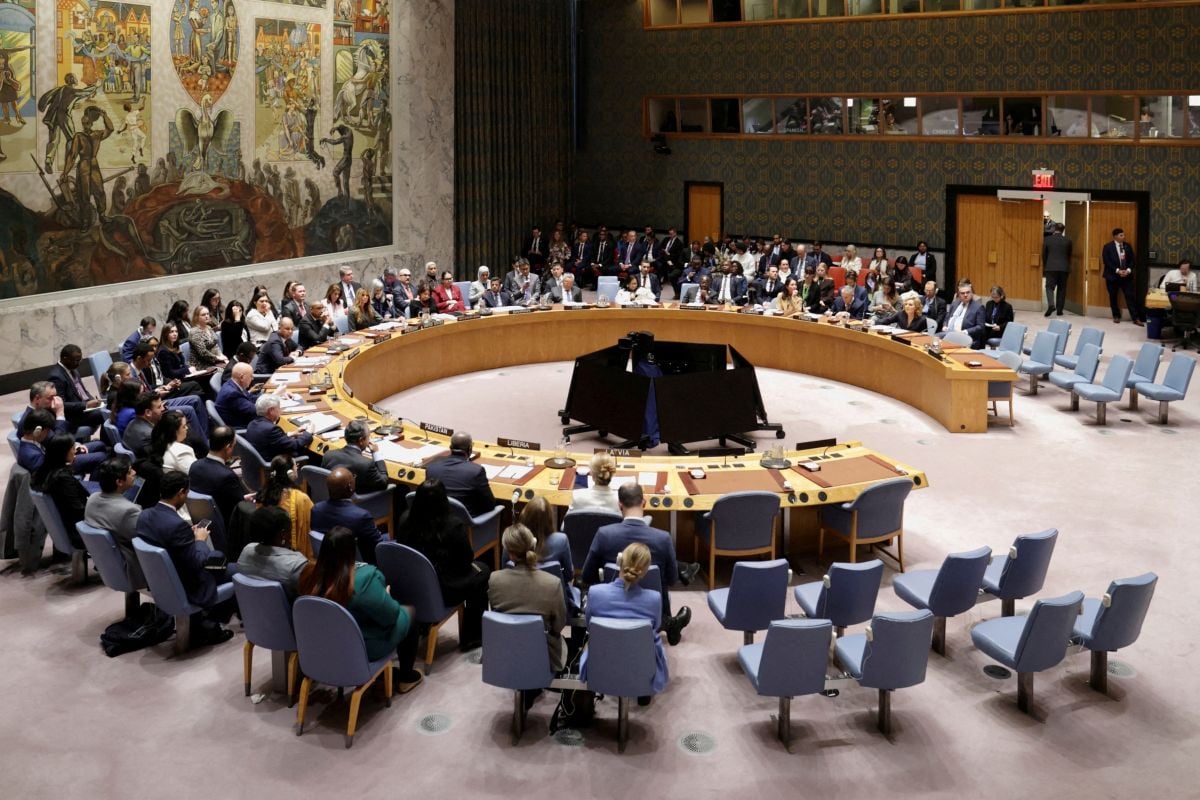
The Security Council met in New York on March 2, 2026. (Credit: Jeenah Moon/Reuters)



The United States told the U.N. Security Council that Bashar al-Assad's regime had "allowed or turned a blind eye" to Hezbollah's activities and captagon trafficking networks, enabling the pro-Iranian group to "sow destruction in Syria and in the region."
In remarks delivered in New York by U.S. Deputy Representative to the United Nations Tammy Bruce, Washington said that the new Syrian authorities, on the contrary, "have disrupted Hezbollah's plans, seized drug shipments, and cooperated with Jordan and Lebanon to fight cross-border crime."
The U.S. administration reiterated its support for international cooperation on transitional justice in Syria, calling on Damascus to work with United Nations mechanisms investigating crimes committed under the Assad regime, especially enforced disappearances.
"We know that hundreds of thousands of Syrian families, as well as several American families, are still waiting for answers about their missing loved ones. To move forward and truly begin Syria's reconstruction, Syrians need to turn the page," Tammy Bruce said. "Institutions such as the Independent Institution on Missing Persons have valuable expertise, and we encourage close cooperation between the Syrian government and international partners to provide answers for families."
Washington also praised Syria's efforts in fighting terrorist networks and said it is working with Damascus within the international coalition against the Islamic State group. "Syria's recent arrests of Assad regime members accused of atrocities against Syrian civilians represent an important step against impunity and in favor of accountability," Tammy Bruce emphasized, stating that "the United States expresses its solidarity with the millions of survivors of violence by the Assad regime."
Ten days ago, the Syrian Interior Ministry announced the dismantling of a cell linked to Hezbollah, whose members had 'infiltrated Syrian territory after intensive specialized training in Lebanon' and were preparing to carry out "a sabotage agenda including targeted assassinations of senior government officials."
Hezbollah played a crucial role during the Syrian civil war, fighting alongside the army of ousted President Bashar al-Assad for a decade. Under Assad, Syria was part of the so-called "axis of resistance" set up by Iran against Israel. It facilitated the transfer of weapons and money from Iran to Hezbollah. The new Syrian authorities, who overthrew the Assad regime at the end of 2024, have rejected Iranian influence and are hostile to the Lebanese party.
Last month, Damascus announced it had foiled a plot against a religious figure near a church "aimed at the security of the Syrian capital." Hezbollah then denied the accusations, reiterating that it "has no presence on Syrian soil."
In February, Syria also announced it had dismantled a cell responsible for attacks on the Mazzeh district of Damascus, claiming that the weapons came from Hezbollah, which once again denied any involvement.

 Trump affirme qu'un accord avec l'Iran « se rapproche grandement »

 Désarmement du Hezbollah : négocier avec l’Iran est-il réaliste ?