




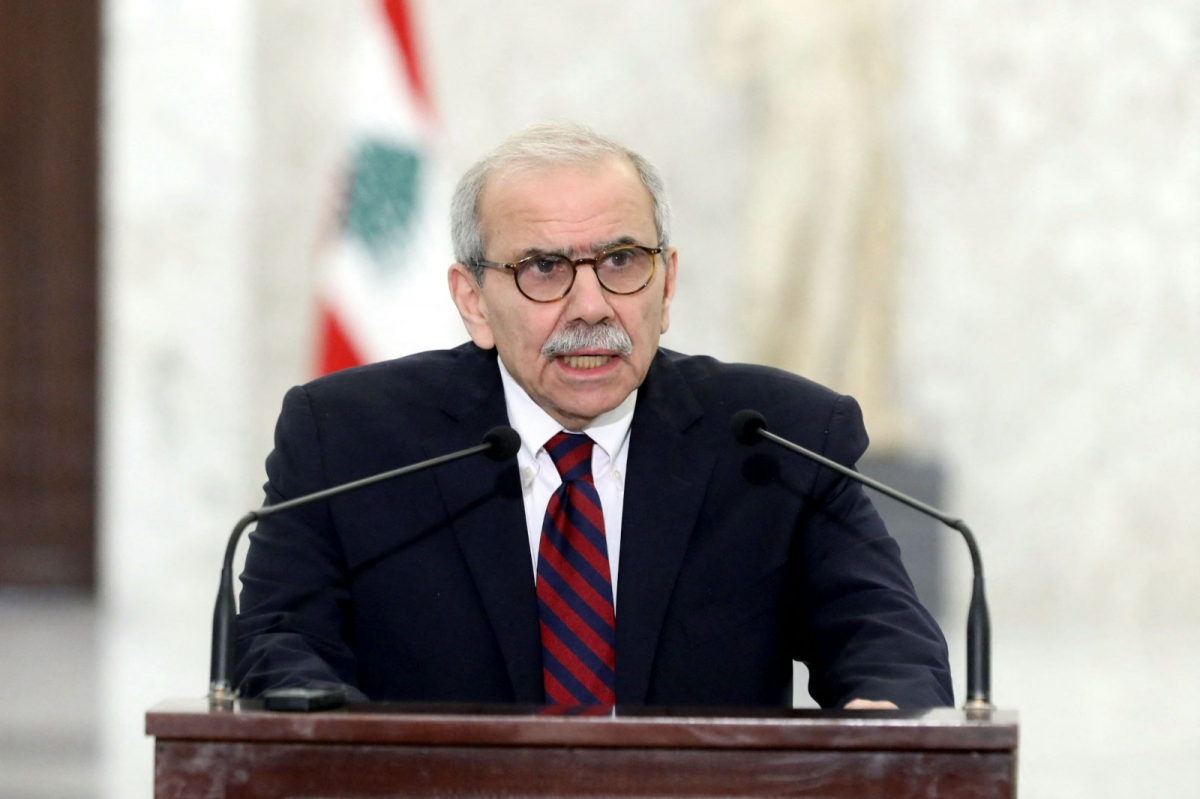
Prime Minister Nawaf Salam giving a speech after a Cabinet meeting at the Baabda Palace. (Credit: NNA)



BEIRUT — Prime Minister Nawaf Salam said Wednesday that “Lebanon is not seeking to normalize its relations with Israel, but rather to make peace,” while stressing that Lebanon’s “minimum requirement” in negotiations is a “clear timetable” for the Israeli withdrawal from the south of the country, and that a meeting between Joseph Aoun and Benjamin Netanyahu at this stage would be “premature.”
During a press briefing on talks with Israel, Salam emphasized that Beirut "is negotiating in its own name," though this does not mean its approach is "totally disconnected from regional dynamics," as talks continue between Iran and the United States.
He said Lebanon’s priorities include, above all, a “clear timetable for Israeli withdrawal,” as well as the full pullout of Israeli forces from more than 600 square kilometers of occupied territory in southern Lebanon, where Israel is seeking to impose a “buffer zone,” along with the return of displaced residents, the release of prisoners, and the settlement of border disputes.
On a possible meeting between President Joseph Aoun and Israeli Prime Minister Benjamin Netanyahu — reportedly encouraged by U.S. President Donald Trump — Salam described such a meeting as “premature.” He said any high-level contact with the Israeli side “requires thorough preparation,” adding that progress must also come through “consolidating the April 17 cease-fire,” which he said is being violated daily by both Israel and Hezbollah. The issue is expected to be discussed in a third preparatory meeting between Lebanese and Israeli envoys in Washington.
'Review' of the arms monopoly plan
Salam also noted that Lebanon–Israel negotiations are not unprecedented, as similar contacts have taken place in the past.
He said the government intends to “review and develop” its plan on the state monopoly over arms, alongside diplomatic efforts to end the ongoing war. He also called for the deployment of an international force in southern Lebanon to “monitor, coordinate, and document” developments on the ground, expressing hope for European participation as the mandate of UNIFIL is set to expire at the end of 2026. He noted that the U.S. and Israel are seeking to exclude France from the mechanism overseeing the Nov. 27, 2024 cease-fire.
Finally, the prime minister emphasized the need to simultaneously conduct an internal dialogue to strengthen the authority of the state and implement the national defense strategy, while calling for the current escalation to be contained by maintaining and reinforcing the cease-fire in the south.
For his part, Parliament Speaker Nabih Berri said in an interview with Al Jazeera that he hoped “Iranian-American negotiations will soon reach a positive conclusion.”
He also said that his relationship with President Joseph Aoun and Prime Minister Nawaf Salam is “solid and important for consolidating stability.”
Addressing Lebanon’s security situation, Berri once again accused Israel of having “violated the cessation of hostilities agreement despite Hezbollah’s commitment,” stressing that “any Lebanese agreement with Israel requires guarantees because it does not respect its commitments.” Iranian Foreign Minister Abbas Araghchi “confirmed to us that Lebanon is part of any agreement with Washington for a cease-fire,” he added.
Berri also said he is “counting on internal unity and the Arab umbrella in the current circumstances.”

 Trump affirme qu'un accord avec l'Iran « se rapproche grandement »
 Désarmement du Hezbollah : négocier avec l’Iran est-il réaliste ?