






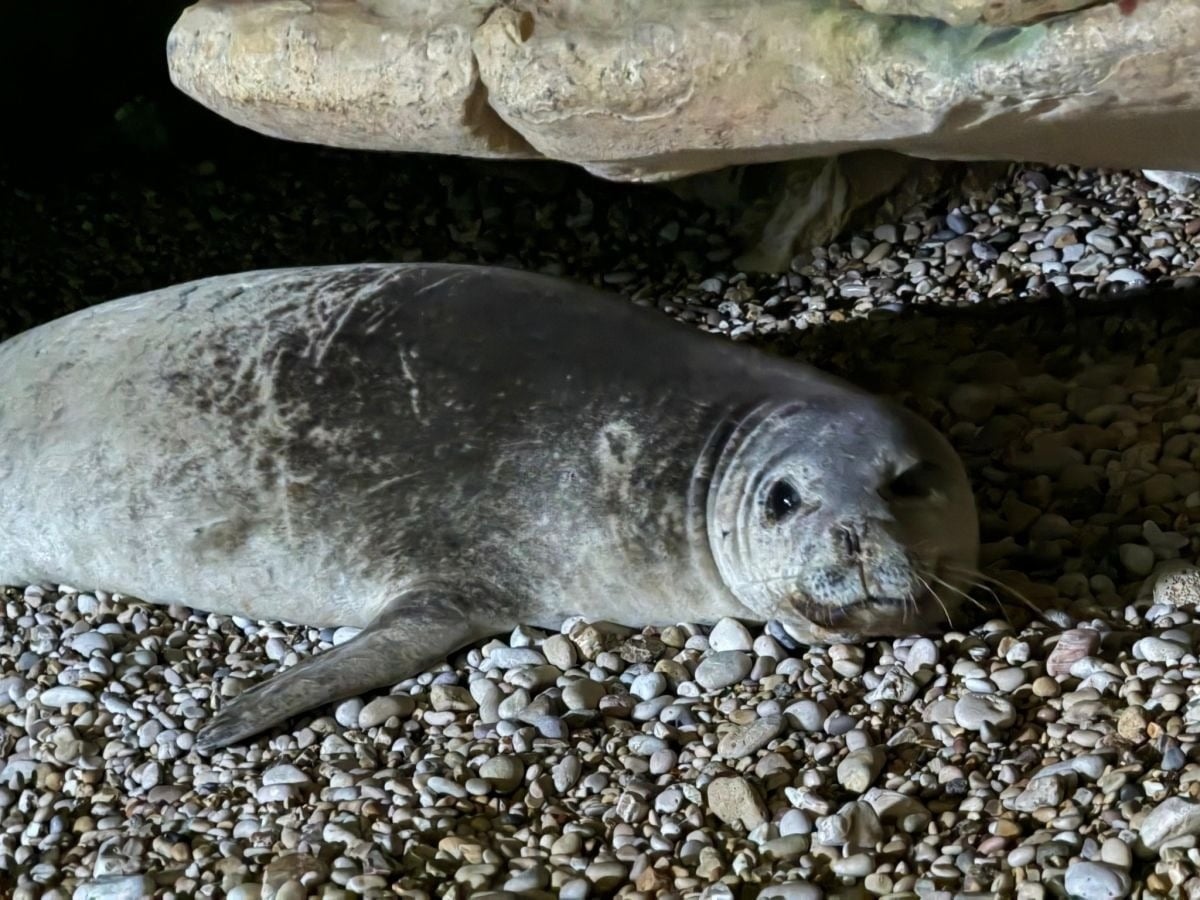
A Mediterranean monk seal on a beach in Lebanon. (Credit: Terre Liban)




BEIRUT — The project to build a private villa on a plot overlooking a cave in Amchit (Jbeil) known to serve as a habitat for the endangered Mediterranean monk seal has returned to the spotlight in recent days.
The environmental group Terre Liban which has been leading opposition to the project, said on Facebook that the State Council appointed an expert to assess the risks posed by the construction to the coastal cave. According to the association and a summary reviewed by L’Orient-Le Jour, the resulting report ''lists 17 construction violations, and a number of executive violations.''
The controversy began in 2024, when environmental activists discovered that work had started on the site. NGOs, including Terre Liban, launched a campaign to halt the project, citing the ecological sensitivity of the area. An initial appeal to the State Council was dismissed because it was filed after the deadline.
Construction resumed in October 2025 before being suspended at the request of Environment Minister Tamara Elzein, who called for a more comprehensive environmental impact assessment. However, work restarted on March 10, 2026, just days after renewed hostilities between Hezbollah and Israel. Around 20 NGOs sent a letter to the ministry on March 15 urging it to stop the project again, but without success.
According to Terre Liban, the expert report marks a significant development in efforts to protect the cave. In a statement posted on social media, the NGO said the 270-page document details violations of construction law, examines the permits granted and emphasizes the need to preserve the site.
The report notes the absence of an environmental impact assessment, which is required for projects near ecologically sensitive areas, and says that a request from the environment minister to carry out such a study was ignored. It also concludes that the work does not comply with the permits obtained, particularly with regard to setbacks and execution.
Most importantly, the report states that, contrary to claims by the project’s supporters that the cave does not extend beneath the construction site, the underground cavity does in fact run under the planned villa.
Regarding the cave itself, the report cites a response from the National Council for Scientific Research (CNRS), which confirmed that the site is uniquely suited to the Mediterranean monk seal, especially as a breeding habitat.
The project’s developers maintain that they obtained all necessary permits and insist that the building site is not located above the cave. In an interview with L’Orient-Le Jour in October 2025, the president of the Amchit municipal council, Joseph Khoury, said the owners had all required authorizations, that he lacked the authority to stop the work, and that a municipal engineer regularly inspected the site.
‘Impressive’ water leaks
While awaiting the State Council’s decision, activist engineer from Amchit, Farid Abi Yunes, said he discovered signs of damage inside the cave and published a video on Tuesday to support his claims.
He reported observing what he described as ''impressive'' water leaks inside the marine cave, which he says indicate that the construction is already affecting the fragile ecosystem. He also filmed significant cracks in the surrounding rock.
According to Terre Liban, the damage documented by the activist was anticipated in a 2024 study by hydrogeologist Wilson Rizk.
Rizk identified the site as consisting of fragile, crumbly Turonian limestone. His conclusions were that the formation could not withstand the excavation work carried out above it, and the digging had already weakened the area, raising ''the possibility of a partial collapse of the cave galleries.''
He warned that the entire site was at risk and stressed that ''it is urgent to seal the cavity created by the works and to move all construction activity away from this site.''

